News Room
Pressroom - Announcements
ISPIN Statement on the U.S. Department of Education’s Proposed Reclassification of Nursing Degrees
International Society for Professional Identity in Nursing Board of Directors
February 2026 / Announcements
The International Society for Professional Identity in Nursing (ISPIN) acknowledges the recently published Notice of Proposed Rulemaking from the U.S. Department of Education concerning the regulatory definition of “professional degree” and its implications for post-baccalaureate nursing education. Under the proposal, graduate nursing degrees such as the MSN, DNP, PhD, and other advanced practice credentials would no longer be categorized among professional degree programs for purposes of federal loan limits and attendant financial support. This change carries important consequences for nursing’s professional stature, graduate education funding, and the future capacity of the profession to meet health system needs.
Professional identity in nursing, defined as the sense of oneself, in relationship with others, that is influenced by characteristics, norms, and values of the nursing discipline, resulting in an individual thinking, acting, and feeling like a nurse, is foundational not only to individual nurse formation but also to the societal recognition of nursing as a profession. ISPIN’s mission centers on advancing the science, visibility, and integration of this identity across education, practice, and regulation. Recognizing graduate nursing education as integral to professional competence and leadership is fundamental to how nursing is perceived, lived, and entrusted by communities and health systems alike.
For nurses seeking advanced practice roles, faculty positions, and leadership pathways, access to comprehensive graduate education is indispensable. Federal student loan support has historically enabled many who might otherwise be unable to pursue these pathways to do so; shrinking access to this financial support can present barriers to entry, hinder diversity in the profession, and ultimately constrain the pipeline of nurse educators and advanced practitioners on whom both workforce growth and quality of care depend.
The ISPIN Board stands in alignment with the American Nurses Association (ANA) and other U.S. nursing organizations in recognizing that how nursing degrees are defined in federal policy affects more than loan limits. It reflects how society values nursing’s contribution to health, safety, and well-being. While policy development is inherently complex, the proposed reclassification raises concerns about its potential to inadvertently undervalue the rigor, expertise, and professional identity cultivated through graduate nursing education.
At this critical juncture, ISPIN encourages its U.S. members to engage thoughtfully and constructively in the regulatory process. The public comment period for this Notice of Proposed Rulemaking remains open through 2 March 2026. Regulatory processes are strengthened when those directly affected contribute informed perspectives grounded in lived experience and professional expertise. As scholars, educators, clinicians, regulators, and leaders committed to advancing professional identity in nursing, ISPIN members are uniquely positioned to articulate why graduate nursing education is inseparable from nursing’s professional formation, public trust, and regulatory accountability.
ISPIN urges members to take the following steps:
Submit an Individual Public Comment
Visit the U.S. Department of Education’s Federal Register comment portal at: https://www.regulations.gov/document/ED-2025-OPE-0944-0001
Click on the blue “Comment” button near the top of the document and follow the instructions to submit your comment before 2 March 2026.The comment should:
Affirm nursing as a profession grounded in discipline-specific knowledge and ethical accountability
Describe how graduate education shapes professional identity, leadership formation, and advanced practice competence
Share your personal and systemic impact of limiting financial access to graduate education
Be personalized with specific examples from your own educational, clinical, research, or regulatory experience has been or would be affected
Engage Your Colleagues, Institutions, and Networks
Encourage schools of nursing, health systems, and professional organizations to submit formal organizational comments.
Share information with colleagues, students, interdisciplinary partners, friends, and family. Individuals are not required to be nurses to submit comments.
Amplify awareness within your professional networks and academic communities.
Graduate nursing education is not merely an academic pathway; it is a structured process of professional formation that cultivates responsibility, authority, clinical judgment, ethical agency, and leadership capacity. How nursing degrees are defined in federal policy carries implications not only for financial access but also for how society understands nursing’s expertise and professional standing. ISPIN remains steadfast in its mission to advance the science and integration of professional identity in nursing and stands with U.S. nurses, educators, and students in ensuring that nursing continues to be recognized, supported, and valued as a profession essential to the health of communities worldwide.
ISPIN remains committed to fostering a nursing profession that is understood, valued, and measured in ways that reflect the discipline’s depth of knowledge, ethical accountability, and essential contributions to health systems worldwide. We stand with all nurses whose futures are shaped by these definitions and with the patients and communities who rely on a strong, well-prepared nursing workforce.
ISPIN Announces 2026 Leadership Team
29 December 2025 / Announcements
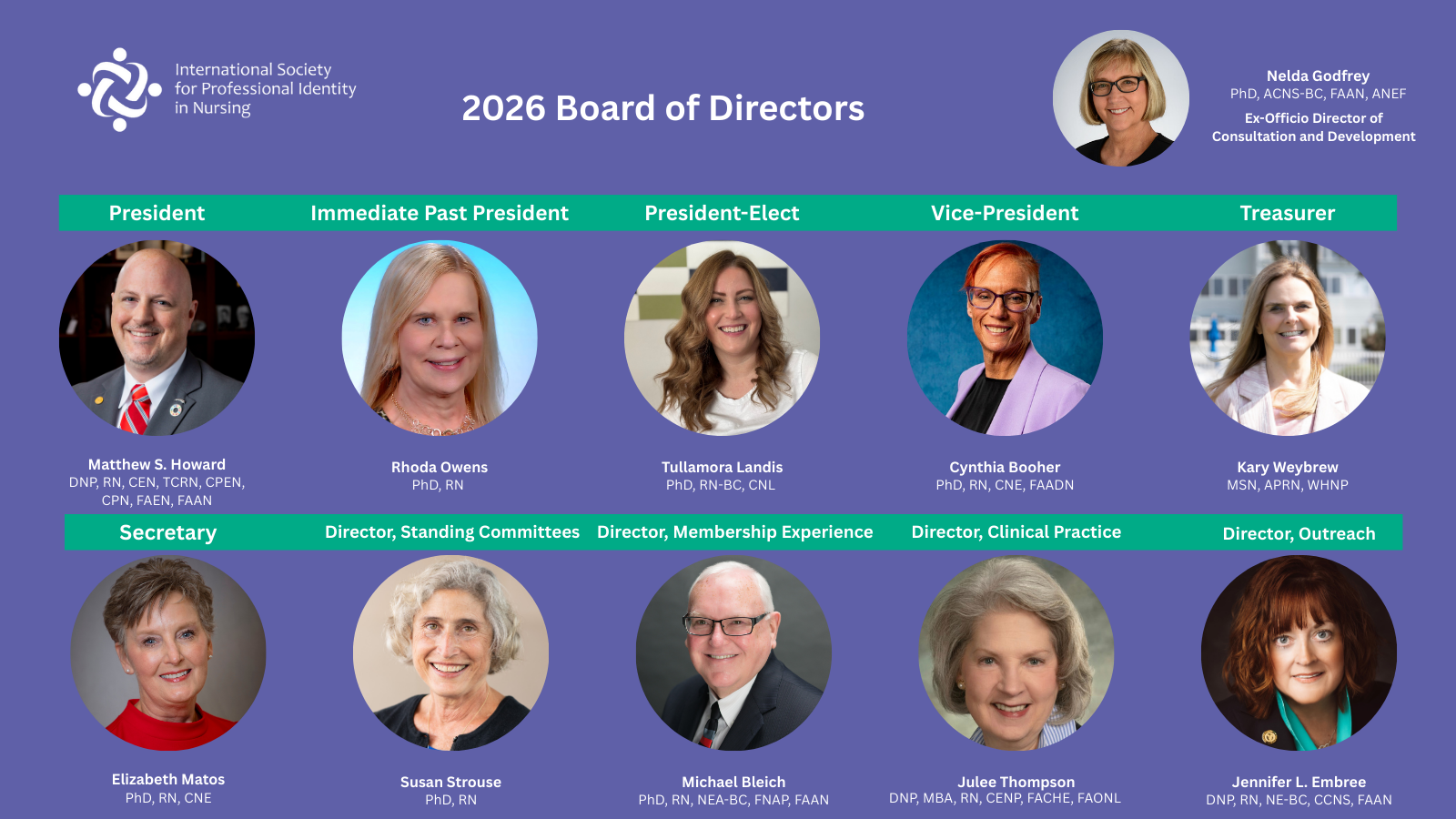
The International Society for Professional Identity in Nursing would like to welcome its 2026 Board of Directors.
President: Matthew S. Howard, DNP, RN, CEN, TCRN, CPEN, CPN, FAEN, FAAN
Immediate Past President: Rhoda Owens PhD, RN
President Elect: Tullamora Landis, PhD, RN-BC, CNL
Vice-President: Cynthia Booher, PhD, RN, CNE, FAADN
Treasurer: Kary Anne Weybrew, MSN, APRN, WHNP
Secretary: Elizabeth Matos, PhD, RN, CNE
Director of Standing Committees: Susan Strouse, PhD, RN
Director of Membership Experience: Michael Bleich, PhD, RN, NEA-BC, FNAP, FAAN
Director of Clinical Practice: Julee Thompson DNP, MSN, MBA, RN, CENP, FACHE, FAONL
Director of Outreach: Jennifer Embree, DNP, RN, NE-BC, CCNS, FAAN, she/her/hers
Ex-Officio Director of Consultation and Development: Nelda Godfrey, PhD, ACNS-BC, RN, FAAN, ANEF